

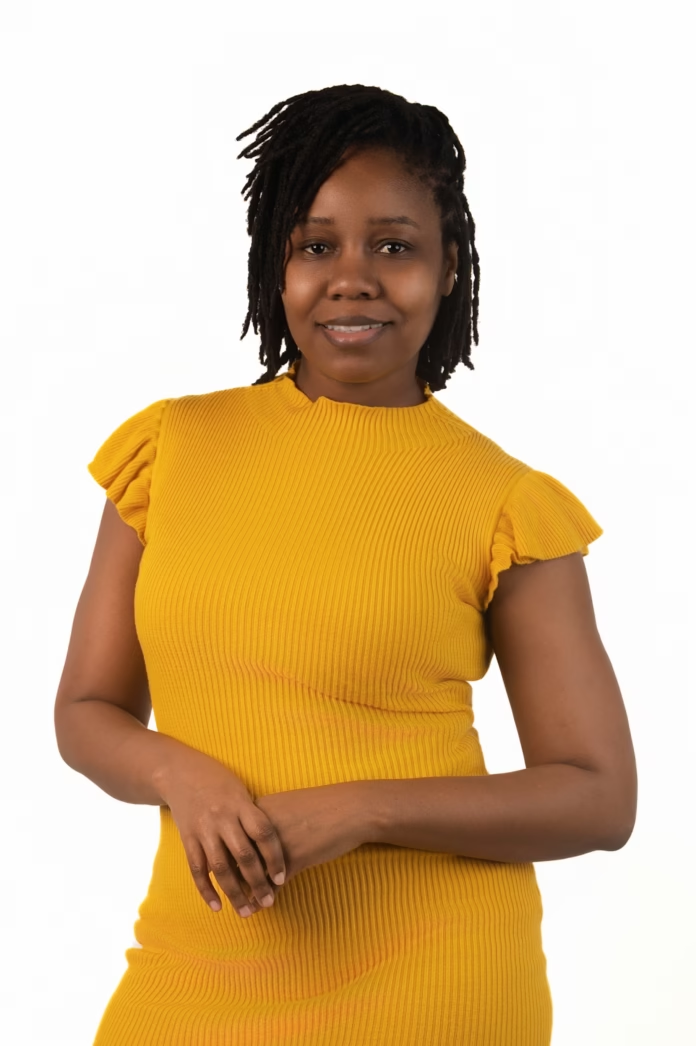
By the time Jessica Paris lifts her camera, the real work has already begun.
Long before the shutter clicks, before light is measured or posture adjusted, something quieter happens in her studio. Conversation slows. Breathing deepens. Stories surface. The photograph, she insists, is never just the image, it is the moment a person gives themselves permission to be seen.
“A great photo is not about perfection,” Paris says. “It’s about truth…when someone feels seen, when they drop the mask, when they allow themselves to exist fully in that moment, that’s where the image comes alive”.

As the founder of Saga Media Photography and a pioneer in Narrative PhotoTherapy, Paris’s work lives at the intersection of visual storytelling, mental health, and identity. Her approach challenges conventional photography and reframes the camera as a therapeutic tool, one capable of healing internal narratives that far too often go unexamined.
Roots That Built Resilience
Jessica Paris’s story begins in Jackson, Mississippi, where she grew up in Presidential Hills, one of the first Black neighborhoods in the state during the 1980s that embodied wealth, pride, and upward mobility. “That environment taught me how to endure,” she reflects. “How to believe in myself before the world confirmed it”.
Her upbringing instilled resilience, but it also ignited ambition. At 19, Paris made a defining decision to leave Mississippi for Texas. “I didn’t arrive fully formed,” she says. “But I arrived willing, and that willingness became the bridge between where I started and everything I’ve been able to build since”.
That bridge would carry her through remarkable personal challenges. Becoming a mother at 16 reshaped her relationship with perseverance, purpose, and possibility. “My early life taught me resilience before I had language for it,” she explains.
From Business to Being Seen
Paris did not initially aspire to photography. She pursued an MBA, intent on building something lasting. But a single elective course, Multicultural Women and Gender Studies, altered her trajectory. “It taught me that when you’re working with people…you have to understand them beyond the surface,” she says.
That realization led her to pause her MBA and pursue a master’s degree focused on identity and lived experience. During that time, she reflected on her earliest memories of feeling confident, memories tied to the portraits her mother displayed at home. “Those images made me feel valued,” she recalls. “They gave me a version of myself to step into”.
Photography became not a career choice, but a calling.
Phototherapy as Practice and Purpose
As her studio grew, Paris noticed a pattern. Technical skill alone could not quiet the self-doubt clients carried into her space. “People would still sit in front of my camera and say, ‘I’m not photogenic,’” she explains. “That’s when I realized the barrier was internal”.
To meet that need ethically and responsibly, Paris pursued a third master’s degree in clinical Mental Health, followed by doctoral research examining how internal and external images shape identity. “The brain processes images faster than words,” she notes. “We feel before we rationalize”.
Her work now bridges that gap. Through Narrative PhotoTherapy, clients explore the internal images they carry, often shaped by criticism, comparison, and cultural expectations, before stepping in front of the lens. “The session becomes less about posing and more about permission,” Paris says. “Permission to be seen without apology”.
To read the complete story, click on the cover of the April 2026 issue.